Bluestone Nostalgia: A Handwritten Font That Elevates Real Small Business Branding
Last Tuesday, I sat at my kitchen table—coffee cooling, label printer humming—with three versions of a new candle jar sticker in front of me. My client, a small-batch candle maker in Portland, had just launched her second scent line and wanted packaging that felt warm, intentional, and unmistakably *hers*. The first draft used a free script font—pretty enough, but flat. The second leaned too formal, like a law firm’s holiday card. Then I opened Bluestone Nostalgia. Within minutes, the “Wild Lavender” label came alive—not because it was flashy, but because it finally *breathed* like her brand: thoughtful, grounded, quietly elegant.
What Makes Bluestone Nostalgia Feel So Human—and So Useful?
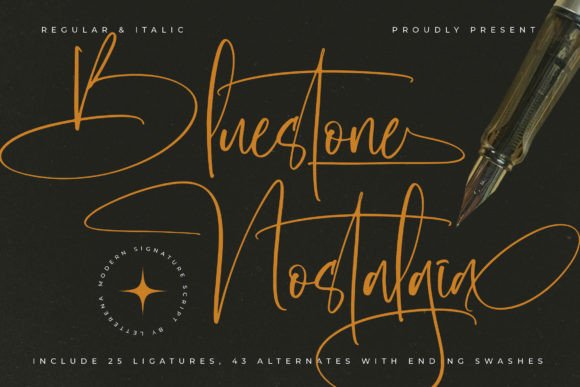
Bluestone Nostalgia is a modern handwritten font from the Script Amp collection, designed with real-world usability in mind. It’s not overly ornate or fussy—no excessive swirls or forced flourishes. Instead, it offers graceful, confident strokes with subtle variation in line weight and rhythm. Think of it as handwriting you’d admire in a well-composed note: relaxed but refined, personal but polished. Its personality lands somewhere between “I made this just for you” and “I know what I’m doing.”
As a creative consultant who helps makers translate their voice into visual form, I’ve tested dozens of script fonts on physical and digital touchpoints. What sets Bluestone Nostalgia apart is how consistently it performs across formats—whether printed at 8pt on a tea bag tag or blown up as a hero banner on an online shop. Its letterforms have just enough contrast and spacing to stay legible without sacrificing charm. And yes—it’s a premium font, but one built for practicality, not just aesthetics.
Where It Shines (and Where to Use It Wisely)
Bluestone Nostalgia works best as a display font: ideal for logos, product names, menu headers, greeting card headlines, Instagram story text overlays, and packaging titles. It’s not meant for body copy—but that’s exactly why it’s so effective. Used intentionally, it creates instant hierarchy and emotional resonance.
- Packaging & labels: On a matte-finish candle jar, Bluestone Nostalgia’s soft curves echo the tactile quality of hand-poured wax. I’ve seen it work beautifully on skincare ingredient tags, bakery box seals, and boutique clothing hangtags—always adding warmth without looking dated.
- Digital presence: As a headline font in Canva templates or Shopify banners, it softens the sharpness of digital interfaces. On mobile, its open counters and generous x-height keep it readable even at smaller sizes—just avoid using it below 14pt for web buttons or thumbnails.
- Printed collateral: Thank-you cards, seasonal flyers, and café menus gain quiet sophistication with Bluestone Nostalgia as the main title font. Paired with a clean sans serif for details (more on pairing in a moment), it balances personality with professionalism.
Smart Pairing—Because One Font Doesn’t Carry the Whole Brand
No script font stands alone—and Bluestone Nostalgia is no exception. Its strength lies in contrast. For nearly every project I’ve used it on, I pair it with a neutral, highly legible sans serif like Montserrat, Inter, or even system fonts like Helvetica Neue. Why? Because Bluestone Nostalgia brings voice; the sans serif brings clarity. Together, they create a visual conversation: one says “this is special,” the other says “this is clear.”
If your brand leans more literary or timeless, try pairing it with a gentle serif like Playfair Display or Lora—just keep the serif light or regular weight to avoid visual competition. Avoid stacking two script fonts unless you’re deliberately aiming for layered texture (and even then, test readability carefully). With Bluestone Nostalgia, less is more: let it lead, then support with type that gets out of the way.
What You’ll Actually Get—and What to Check Before You Use It
Bluestone Nostalgia comes as part of the Script Amp family, meaning it includes standard OpenType features: ligatures, stylistic alternates, and multilingual support covering Western European languages. File formats are .OTF and .TTF—fully compatible with Adobe Creative Cloud, Affinity apps, Cricut Design Space, and most major design tools.
Before launching anything customer-facing, always verify the license. This is a commercial font, fully cleared for use on product packaging, social media graphics, client projects, and digital downloads—no hidden restrictions. But do check whether your license covers merchandise (like tote bags or mugs) if that’s part of your plan. Also, preview the full character set: some script fonts skimp on numerals or punctuation, but Bluestone Nostalgia includes thoughtfully designed figures and symbols that hold up in mixed-use contexts—like pricing on a café menu or batch numbers on a soap label.
A Small Change With Real Brand Impact
Here’s what surprised me most after using Bluestone Nostalgia across six different small business projects this season: customers started commenting—not on the font itself, but on how the brand suddenly felt *more cohesive*. A boutique owner told me her Instagram DMs shifted from “Do you ship to Texas?” to “Your packaging feels like a gift before it even arrives.” A local café noticed repeat guests pausing longer at the new menu board—not because the food changed, but because the typography invited them to linger.
That’s the quiet power of intentional typography. Bluestone Nostalgia doesn’t shout. It doesn’t trend-hop. It simply gives your brand a consistent, human-scaled voice—one that reads as trustworthy because it feels considered, not automated. Whether you're updating a single product label or building a full brand identity system, it’s the kind of design asset that pays off in perceived value, recognition, and quiet confidence.
If your goal is to look like the kind of small business people remember—not because you’re loud, but because you feel true—Bluestone Nostalgia is worth every thoughtful minute you spend choosing it.